Epicor vs. NetSuite is a common comparison distributors make when looking for an Enterprise Resource Planning (ERP) solution. Epicor Prophet 21 works well for distribution-focused inventory, as it emphasizes purchasing and warehouse management. NetSuite provides a broader cloud ERP for managing financial and operational processes.
For distributors who are considering moving to an ERP for the first time, the first question should be whether they need an ERP, or if building better workflows around their existing accounting system would suffice.
For small to mid-sized distributors moving over from spreadsheets or a small CRM, Method CRM offers a solution that’s fully customizable and less complex. This guide examines all three options so you can find the right fit for your current situation.
TL;DR: Epicor vs. NetSuite vs. Method
- Epicor Prophet 21: Distribution ERP with integrated inventory management, purchasing, warehouse, and branch operations.
- NetSuite: Cloud-based ERP providing financial management, inventory management, and multiple entity management for companies looking for breadth of function beyond their current capabilities.
- Method: Customizable CRM and workflow automation platform for distributors who wish to continue using QuickBooks but improve customer-facing operations.
- Compare the full investment: All costs associated with the software, implementation, migration, training, and ongoing administration should be considered
Epicor Prophet 21 vs. NetSuite vs. Method at a glance
Each product differs in what it’s designed to manage. Prophet 21 and NetSuite can replace a distributor’s existing accounting system with an ERP. Method connects to QuickBooks and adds CRM and operational workflows around it.
| Decision factor | Epicor Prophet 21 | NetSuite | Method |
| Software category | Distribution ERP | Cloud ERP and business management suite | Customizable CRM and workflow platform |
| Accounting | Integrated financial management | Integrated financial management | Retains QuickBooks Online or Desktop |
| Inventory | Distribution-focused inventory and replenishment | Inventory and supply chain management | Works alongside QuickBooks or a dedicated inventory system |
| Warehouse operations | Dedicated warehouse management capabilities | Warehouse management capabilities, depending on modules | Not a native WMS |
| Customer workflows | CRM and sales functionality within its ERP ecosystem | CRM capabilities within the suite | Customer management, quoting, service workflows, and customization |
| Implementation | ERP implementation and data migration | ERP implementation and data migration | Connects to existing QuickBooks records; customization scope varies |
How much do Method CRM, Epicor Prophet 21, and NetSuite cost?
For a small distributor with 10 licensed users, Method CRM’s standard subscription costs range from $350 to $970 per month, depending on the plan. Third-party estimates put Epicor Prophet 21 at approximately $2,000–2,750 per month and NetSuite at $1,989–2,989 per month.
| Software or plan | Monthly subscription equivalent for 10 users (USD) | What the price reflects |
| Method CRM Quick Start | $350 | Customer and vendor management, activity tracking, and QuickBooks integration. |
| Method CRM Pro | $590 | Adds sales pipelines, estimates, sales orders, invoices, and payments. |
| Method CRM Enterprise | $970 | Includes purchase orders and bills, which are available as paid additions in Pro. |
| Epicor Prophet 21 | Approximately $2,000-2,750 | Third-party estimate: $1,000 monthly platform fee plus 100–175 per user. |
| NetSuite | Approximately $1,989-2,989 | Third-party estimate: $999 monthly base fee plus 99–199 per full user, excluding optional modules. |
Method totals reflect standard CRM subscriptions for 10 users on the same plan.
First, decide whether your distribution business needs a full ERP
Enterprise resource planning (ERP) software connects core business processes, including financial management, procurement, inventory control, and order fulfillment. A CRM is a customer relationship management tool. Although there is some overlap, both systems serve different business needs. For example, a distributor with thousands of SKUs and multiple warehouses might need to integrate their replenishment with their branch transfer and/or purchasing functions. In this case, they might need a specialized distributor ERP.
A second distributor may be using a reliable version of QuickBooks for accounting purposes and a stand-alone inventory program, yet still face issues with the quoting process, customer service follow-up, and technicians’ access to historical information about the equipment serviced. Replacing the accounting system alone does not guarantee these workflow problems will be resolved. A customer relationship management (CRM) system that integrates with the current QuickBooks accounting system could provide solutions for these gaps without requiring a replacement for the current accounting system.
Can a customizable CRM serve as an ERP alternative?
For some distributors, a customizable CRM can provide the operational workflows they would otherwise seek in an ERP. The opportunity extends beyond managing customer relationships: distributors can build solutions around their inventory, order processing, and service requirements.
Go Powertrain took this approach. The automotive components distributor initially searched for an ERP, then used Method CRM’s customization capabilities to build a connected system across sales, inventory, warranty, shipping, and accounting.
Go Powertrain built a custom inventory module supporting multiple warehouses and e-commerce synchronization, along with tailored warranty workflows. It reduced its estimate-to-invoice process from 60 steps to six and increased its in-stock fill rate from approximately 20 to 40 percent.
For distributors evaluating a similar approach, compare the cost of Method, QuickBooks, and the customization needed for your workflows against an ERP configured for those same requirements.
Identify the problem before choosing the platform
Inventory and warehouse control
Evaluate an ERP software or dedicated inventory system with regards to stock accuracy or picking items. If broader supply chain management is also a concern, include supplier lead times and purchasing coordination in the evaluation.
Financial consolidation
Evaluate ERP capabilities when multiple legal entities, currencies, or complex financial reporting exceed the current accounting setup.
Customer and sales workflows
Evaluate a distribution CRM when quotes, customer records, orders, and service information remain disconnected.
Several problems at once
Map the complete process and establish which system will own accounting, inventory, customer records, and operational data.
If QuickBooks is already handling accounting reliably, preserving it should be part of the evaluation, even if the original software search started with ERP.
The key distinction: A distributor does not necessarily need to replace its accounting software to improve the processes connecting sales, operations, and accounting.
For QuickBooks-based distributors, Method CRM offers a way to connect those workflows without replacing the accounting system.
How we evaluated Epicor Prophet 21, NetSuite, and Method
Method is our product. This assessment draws on current first-party product materials, available pricing information and Method’s experience working with industrial and equipment distributors.
We evaluate each solution against the following criteria:
- Fit for industrial equipment distribution.
- Inventory, warehouse, purchasing and branch depth.
- Financial and multi-entity requirements.
- CRM, quoting and customer visibility.
- Serialized equipment, parts and service workflows.
- QuickBooks continuity versus replacement.
- Customization, implementation and ongoing administration.
- Total cost of ownership.
Epicor Prophet 21 is designed around distribution operations
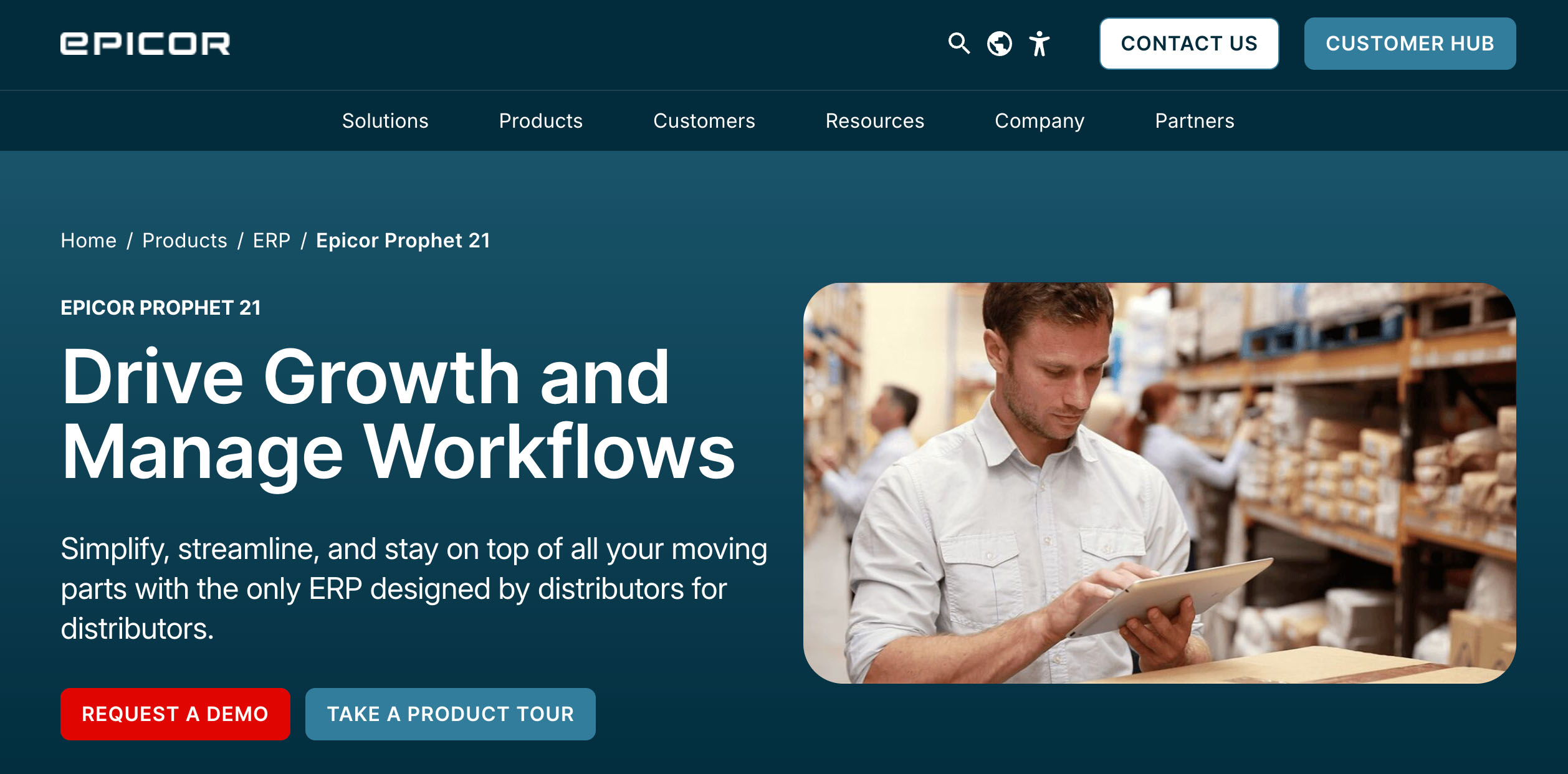
Epicor offers multiple ERP products known for their user interface and overall user experience. Prophet 21 focuses on wholesale distribution, connecting purchasing, inventory, warehouse activity, customer orders, and financial management. For an industrial distributor, this means managing the movement of products through the business within an integrated ERP environment.
Where Prophet 21 supports industrial equipment distributors
Consider a supply house that sells filters, hydraulic components, and replacement parts to commercial customers. It needs to know what is available, what has already been committed, and what must be purchased.
Prophet 21 provides capabilities for:
- Inventory management: Stock visibility, inventory replenishment, and purchasing decisions across locations.
- Purchasing: Supplier orders, special orders, and procurement activity connected to demand.
- Warehouse management: Receiving, put-away, picking, and inventory movement through its WMS capabilities.
- Order management: Customer orders connected to fulfillment and financial transactions.
- Financial management: Accounting and operational reporting within the ERP.
What should distributors verify before selecting Prophet 21?
Ask Epicor to demonstrate your branch, parts and service workflows, including any requirements for serialized equipment. Confirm which capabilities are included in the proposed configuration and which require additional modules or integrations.
For a distributor already managing accounting and inventory successfully in QuickBooks and an inventory application, assess whether broader operational needs justify an ERP replacement. Include data migration, employee training, customization and ongoing administration in that assessment. If the main gaps involve estimate follow-up or service coordination, compare the scope of the proposed implementation with those specific needs.
NetSuite connects financial management with broader business operations
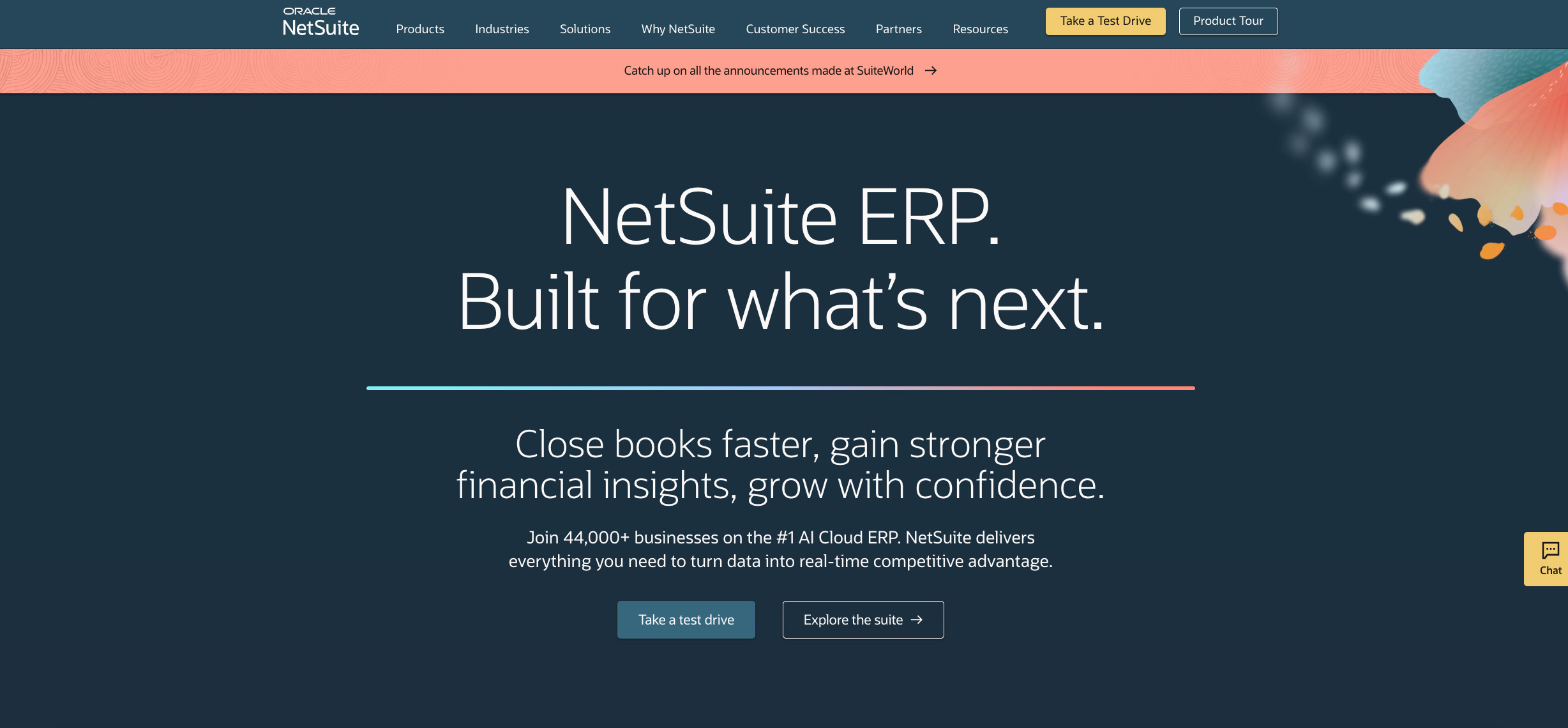
NetSuite is a cloud ERP that marries financial management with operations. It covers various verticals, including inventory, order management, procurement, and classic CRM offerings such as lead management and customer visibility.
Where NetSuite supports industrial equipment and distributors
NetSuite offers various capabilities for different types of work.
NetSuite offers capabilities for:
- Financial management: General ledger, accounts payable, accounts receivable, and financial reporting.
- Multi-entity operations: Subsidiary management and consolidated reporting through capabilities such as NetSuite OneWorld.
- Inventory and purchasing: Stock management, replenishment, procurement, and order processing.
- Warehouse operations: Picking, receiving, and other warehouse processes through relevant capabilities and modules.
- CRM: Customer records and sales activity within the wider business suite.
This makes NetSuite especially relevant as a distributor’s operational requirements become more complex.
What should distributors verify before selecting NetSuite?
Ask NetSuite to demonstrate your branch, parts and service workflows, including any requirements for serialized equipment. Confirm which capabilities are included in the proposed subscription and which require additional modules or integrations.
For a distributor considering replacing QuickBooks, assess whether its financial and operational requirements justify the transition. Include data migration, employee training, customization and ongoing administration in that assessment. If retail or e-commerce is part of the business, request a demonstration of how those orders update inventory and financial records, and confirm the software, integrations and costs required.
Method CRM connects customer and operational workflows to QuickBooks
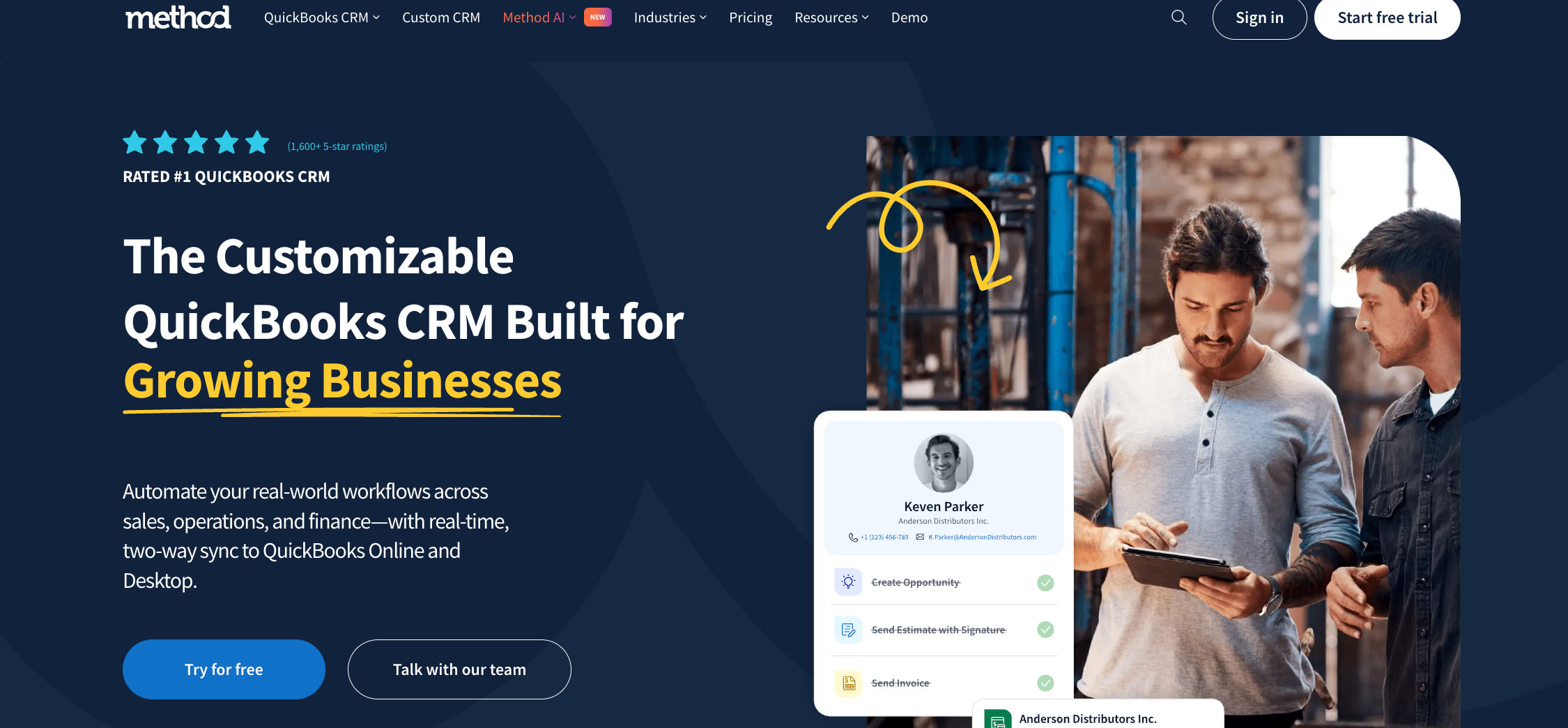
Method CRM is a customizable CRM and workflow platform with a two-way connection to QuickBooks Online and QuickBooks Desktop. For an industrial equipment distributor, it connects customer and operational workflows to the accounting software the business already uses.
Where Method supports industrial equipment distributors
Consider an equipment dealer that uses QuickBooks for accounting but separate spreadsheets for estimate follow-up, equipment details and service requests. Its team needs to connect those activities without repeatedly entering customer and transaction information.
Method offers capabilities for:
- Customer management: Customer, lead, quote, order and interaction history together.
- Transaction workflows: Estimates, supported sales orders, purchase-order-related workflows and invoices connected to customer activity.
- Equipment and service records: Configurable fields for model, serial number, site, warranty dates and service history.
- Team access: Role-appropriate workflows for outside reps and technicians without direct QuickBooks access.
- Portals and customization: Customer portals and automations for approvals, documents, payments and repeat requests, with support from Method’s customization team. Transaction support varies between QuickBooks Online and Desktop.
Method performed internal research involving 39 industrial and equipment distribution customers and prospects. In that group, 72 percent stated that they have had to work around some sort of problem relating to getting their data from QuickBooks to another system. Forty-four percent of respondents identified problems related to creating a quote or order, and 62 percent described friction with software limitations or customization requirements.
What distributors should verify before selecting Method
Ask Method to demonstrate your quoting, equipment and service workflows. Confirm supported transactions, customization requirements and implementation costs for your QuickBooks version.
Method extends QuickBooks rather than replacing it with an ERP. It suits distributors seeking better customer management and operational handoffs, and can work alongside an inventory application responsible for stock and warehouse operations.
How the three options handle everyday distribution workflows
The following breaks down how all three options handle different challenges related to distribution workflows.
Managing complex quotes and customer-specific pricing
Industrial distributors often need to account for changes in supplier costs, negotiated customer prices, and non-stock items when preparing a quote. An accepted estimate may also require approval before purchasing begins.
| System | Quoting approach |
| Prophet 21 | Connects distribution pricing, customer orders, purchasing, and fulfillment within its ERP. |
| NetSuite | Connects sales transactions with financial and operational processes; configuration determines the quoting workflow. |
| Method | Connects customer records, estimates, follow-ups, and QuickBooks transactions through customizable CRM workflows. |
Moving an approved quote into purchasing and fulfillment
Once the customer approves a quote, the business must determine whether the product is available and what else is needed in terms of logistics.
- Quote approved
- Sales order created
- Stock availability confirmed
- Purchase missing items, if needed
- Fulfill order
- Invoice
Prophet 21 and NetSuite can connect inventory, procurement and fulfillment within their ERP environments, depending on the licensed capabilities and configuration.
Method connects customer-facing workflows to QuickBooks, keeping it as your accounting system while inventory remains in QuickBooks or a dedicated inventory application.
Keeping customer and equipment history together
Equipment dealers will need to know what the customer purchased. They will also need to know where each of their machines is located and what has happened to them since delivery. Prophet 21 and NetSuite offer ERP and service-related capabilities that should be evaluated against the dealer’s requirements and available modules.
Method can be configured around customer-linked equipment records, warranty details, and service history.
One real use case can be seen in that of HealthLinc Medical Equipment. The company uses Method to coordinate quotes, work orders, invoicing, and technician scheduling, all integrated into their QuickBooks-based accounting system.
HealthLinc reported a 20–30 percent reduction in order processing time and 66 percent reduction in data collection time. Those results describe its specific implementation, not guaranteed outcomes for every distributor.
“It’s really the lifeline of everything that happens in the company,” Cameron Fleming, President of Operations at HealthLinc said. “Having Method communicate with our accounting software means that there’s just an easy flow — we execute our orders and then magically they translate into our accounting system.”
Coordinating parts and field service after the sale
When a customer requests services, the office will require identification of the piece of equipment involved in the issue. The office will also need to determine what type of service request the customer has made. After determining both factors, the office can forward this information to the assigned technician so they have all relevant details prior to their visit.
After completing work on the customer’s equipment, the technician may be required to document the completed work. Additionally, depending on how the organization prefers to do business, the technician may need to receive approval from an authorized staff member before returning and providing the necessary documentation to the billing department to generate an invoice.
Prophet 21’s Service and Maintenance module connects service orders, equipment serial numbers and warranty details, with enhanced mobile capabilities available through Epicor Field Service Management.
NetSuite Field Service Management connects scheduling, equipment history and parts usage, with mobile tools for recording work and preparing completed tasks for billing.
Method for Field Services supports work orders and mobile access while keeping QuickBooks for accounting. Pricing depends on user roles and required apps. Equipment records and approval steps can be customized, with scope and costs confirmed during implementation planning.
Operating across warehouses, branches, and business entities
These requirements often appear together, but they are not the same problem. Assess scalability against your actual plans, whether that means more warehouses or something else.
| Requirement | What the business needs to evaluate |
| Multiple warehouses | Stock by location, bins, picking, replenishment, and transfers. |
| Multiple branches | Customer ownership, territories, staff permissions, and location-specific workflows. |
| Multiple legal entities | Separate accounting records, financial consolidation, currencies, and intercompany transactions. |
Prophet 21 addresses distribution and branch operations, while NetSuite offers broad financial and multi-entity management capabilities, including OneWorld.
Method can support customer-facing branch workflows, but advanced warehouse control and consolidated multi-entity accounting require the appropriate inventory or financial system.
NetSuite vs. Epicor vs. Method: Total cost of ownership
The earlier pricing table provides a starting point for comparing subscriptions. The full investment depends on which systems each option replaces, what remains connected and how much work is required to support your workflows.
For Prophet 21 and NetSuite, assess the cost of implementing an ERP and migrating from existing systems. For Method, include the combined cost of Method, QuickBooks, any inventory application and the customization or integrations required.
Use the same requirements to evaluate each proposal:
| Cost area | Questions to ask |
| Software | Which user licenses, modules, and add-ons are included? |
| Implementation | What work is included in the proposal, and what requires additional services? |
| Migration | Which QuickBooks, customer, inventory, and equipment records must move? |
| Customization | How will existing quoting, service, and approval processes be recreated? |
| Training | How much time will employees need to learn the new system? |
| Administration | Who will maintain permissions, integrations, reports, and workflows? |
| Expansion | What happens when the business adds users, warehouses, branches, or entities? |
What makes ERP implementation more expensive?
With ERP solutions, deployment options also affect the investment. Costs may change as a result of adding warehouse modules, migrating legacy data, customizing your process, or on-premises deployment. Changing an accounting system can involve more than just moving customer names and invoice balances from one system to another. The company will likely have to go through several steps, such as reconciling historical data and validating the financial process before putting the new system into use.
Ask which professional services are included in the implementation quote and which cost extra. Also confirm what the recurring fee covers, including updates, support, and data storage.
How does keeping QuickBooks change the investment?
A QuickBooks-connected CRM lets you build on the accounting system you already use. Method connects customer data, quoting, sales and service workflows to QuickBooks through its two-way sync, with customization to fit how your business operates. Your investment focuses on improving those processes while keeping QuickBooks in place. If you also need a dedicated inventory or warehouse system, include its software, integration and setup costs in the comparison.
Which option fits your industrial equipment distribution requirements?
The distinction comes down to what the business needs its next system to own.
Distribution operations
Evaluate Prophet 21 when warehouse execution, replenishment, purchasing, and branch inventory are the central requirements.
Broad financial management
Evaluate NetSuite when the business needs a cloud ERP with financial consolidation and operational management across entities.
QuickBooks-based workflows
Evaluate Method when accounting works but customer records, quoting, order handoffs, and service processes need improvement.
Combined requirements
Evaluate a connected system architecture when advanced inventory and tailored customer workflows require different applications.
Questions to ask during every distribution software demo
Ask each vendor to demonstrate your actual workflows and explain what comes standard, what requires customization or additional modules, and what relies on connected systems.
Frequently asked questions
Epicor Prophet 21 is the stronger fit when your main requirements are distribution-specific purchasing, inventory replenishment, warehouse management, and branch operations. NetSuite is the stronger fit when you need a broader cloud ERP with financial consolidation and management across multiple legal entities. The key difference will depend on what the distributor requires.
No. Method is a customizable CRM and workflow platform that extends QuickBooks Online and Desktop through a real-time, two-way sync. It connects customer management, quoting, orders, invoicing and service coordination while keeping QuickBooks as the accounting system. For distributors, Method can be tailored around equipment records, approvals and operational workflows, with support from its customization team. It can also work alongside dedicated inventory software.
Yes. If QuickBooks meets all their accounting needs, they could then consider purchasing a CRM tool to work with their current inventory program as needed. As requirements grow, distributors can evaluate whether customization and connected tools can support their next stage or whether a broader ERP would be a better fit.
NetSuite includes its own accounting and financial management capabilities and can replace QuickBooks as the company’s financial system. Businesses considering the switch should evaluate migration requirements and implementation costs.
Distributors that also handle manufacturing should assess their production needs separately. An MES (Manufacturing Execution System) tracks shop-floor activity, while an ERP connects broader financial and operational processes. When evaluating SaaS solutions, consider how they will connect production, inventory and customer information. For businesses keeping QuickBooks, Method can support customer and operational workflows alongside specialized production tools, with integration requirements confirmed during scoping.
Start with the workflow your business needs to improve
The right choice depends on where your current systems fall short. Prophet 21 focuses on distribution operations, while Oracle NetSuite brings financial and operational management together, with options for requirements such as multi-entity reporting and revenue recognition. If QuickBooks already meets your accounting needs, Method can connect quoting, customer support and service workflows through a customizable CRM.
Whether you’re planning a NetSuite implementation, evaluating Prophet 21 or extending QuickBooks with Method, compare the complete solution: software, customization, training and ongoing support. Start with the processes you need to improve, then ask each vendor to demonstrate how its proposed setup will support them.